

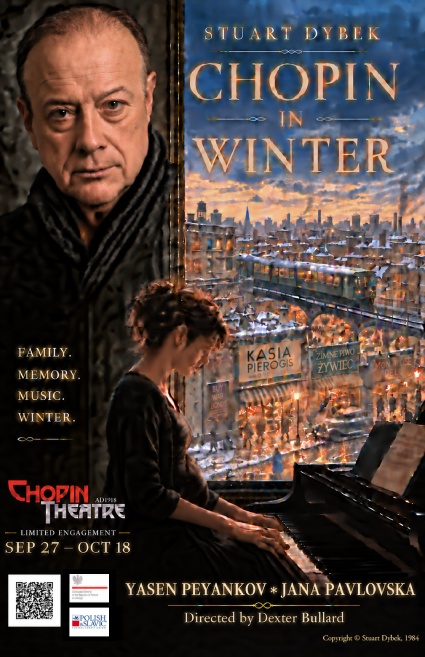
Chopin Main Stage
Sep 27 - Oct 18
Fri-Sat 7pm. Sun 3pm (75 mins)
"an imaginative work of art" – Angela Lin, Broadway world
Reader Recommended – "Stuart Dybek's short story receives a warm and poignant staging at Chopin Theatre" – Kerry Reid Chicago Reader
✭✭✭"A rich meeting of Dybek's Chicago storytelling and Chopin's music" – Nancy Bishop, Third Coast Review
"even more poignant on the stage..a generous gift that transports us to another time and place" – Don Evans, Chicago Literary Hall of Fame
"quiet, hypnotic direction of Dexter Bullard..warm and engaging Yasen Peyankov..beautiful piano solos of Jana Pavlovska" – Richard Green, Talkin' Broadway
„Głęboko poruszająca opowieść o pamięci, rodzinie, emigracji i muzyce... znakomicie wykonana przez duet Peyankova i Pavlovskiej."
– Ewa Malcher, Dziennik Związkowy
"subdued, intimate and beautiful.. much like a Chopin nocturne"
– Mitchell Oldham, Splash Magazine
"The beauty of the prose and the beauty of the notes lead the meaning... The effect is especially powerful."
– Jeff Link, The Loyola Phoenix
Recommended"Stunningly beautiful...perfect example of the Chicago tradition of bringing great literature to the stage...it's too bad this gorgeous show has such a short run...it's why we go to the theater."
– Mary Wisniewski, Newcity Stage
$30-$40 ($25, 9/27 preview)
info@ChopinTheatre.com
Free parking courtesy Holy Trinity Church,
1 block East of Chopin
| buy tickets |
 |
 |
 |
 |
 |

Sept 27 - Oct 18
"Chopin at the Chopin Theatre is only appropriate, and Chopin Theatre's newest theatrical production brings that vision to life. Directed by Dexter Bullard based on Stuart Dybek's short story, Chopin in Winter features Yasen Peyankov delivering a captivating monologue to the backdrop of Chopin performed by pianist Jana Pavlovska.
The story is set in a post-war Polish neighborhood in Chicago. Told from the first-person memory of the narrator, Yasen Peyankov portrays the young boy transfixed by the piano music coming from Marcy, the pregnant daughter of his landlady who lives upstairs. His grandfather Dzia-Dzia spends most of his time soaking his feet in the kitchen, where Chopin floats through the walls and the two connect through sparse conversation to this piano backdrop that fades over time.
October is Polish American Heritage Month, and Chopin in Winter is a beautiful tribute to one of Poland's most celebrated composers while depicting the post-WWII experience of immigrant families through a particularly poignant and specific memory. Under Bullard's creative direction, the production features Yasen Peyankov reading "on book" as an artistic decision.
Just as pianists can choose to follow the score rather than memorize a piece, so Bullard chooses to let Peyankov interpret the lines fresh off the page as he paints the picture of the immigrant family experience through the eyes of a child and the lasting impact of music — and the subsequent silence — through Dybek's lyrical prose. By the end of the show, the script is strewn across the simple stage as the descriptions of the working-class Chicago neighborhood fly off the page as Peyankov paces the barren apartment set and takes us on a trip down memory lane.
From the first notes of Nocturne in C-Sharp Minor that chillingly meld with Peyankov's words to the rapid flurry of technique in Ballade in G-Minor, Op. 23, No. 1 transformed with the spirit of boogie-woogie, Pavlovska's poetic piano performance exudes emotion and warmth, completely changing the atmosphere of the one-man show using Chopin's greatest pieces and even newly re-discovered songs. Pavlovska artfully weaves the range of Chopin's compositions into the narrative, bringing Dybek's words to life through the magic of music.
The production is intimate, rooted solely in Peyankov's voice and Pavlovska's touch. While some pieces offer a lively tempo that changes the rhythm of the performance, the show is generally slow, contemplative, and descriptive, relying on the meditative narrative to evoke the memories of poverty, exile, and survival. This show might not be everyone's speed — especially for those looking for plot-driven dialogue or flashy theatrical production — but it's an imaginative work of art for those with an acquired taste of deep storytelling combined with some of the most beautiful piano compositions from the Romantic era.
Chopin in Winter plays at the Chopin Theatre MainStage (1543 W. Division St.) through October 18, 2026. Tickets are $40 adults and $30 students and seniors. - Photo credit: Charles Osgood
READER RECOMMENDED – Chopin in Winter remembers a vanished Chicago
Stuart Dybek's short story receives a warm and poignant staging at the Chopin Theatre. – Kerry Reid, Chicago Reader 9/30/26
"It might feel too on the nose to have a piece called Chopin in Winter onstage at the Chopin Theatre. But I think you'd be hard-pressed to find a better venue for Stuart Dybek's short story than the mainstage at the longtime Wicker Park theater—unless you went with an actual environmental staging in an old Chicago apartment building.
The cavernous space at the Chopin features swathes of white fabric hanging down like ghosts at the rear, with the apartment rooms suggested by old furniture—a single bed, a dining room table, a writing desk—lit by dim but warm lamps (lighting design by Adam Jezl-Sikorski) that create the atmosphere of a memory play haunted by the dead and disappeared souls in Dybek's tale.
Directed by Dexter Bullard, it's not exactly an adaptation of Dybek's story, which first appeared in his 1990 collection, The Coast of Chicago. (Twenty years ago, Walkabout Theater Company and Lookingglass collaborated on a stage version of that collection that drew heavily on "Chopin in Winter.") Instead, Steppenwolf ensemble member Yasen Peyankov reads the entire story from typed sheets of paper over the 75 minutes of the performance. He's accompanied by Jana Pavlovska on a grand piano upstage left, delivering soulful renditions of Chopin's nocturnes, preludes, and waltzes, in the process becoming Marcy, the daughter of the narrator's landlady, Mrs. Kubiac.
As Bullard explains in a director's note, "The actor is intentionally ‘on book' interpreting the story live from the page. Even as the pianist follows the score, so here does the actor—very concretely they remain artists weaving the text and notation into the present." Peyankov's lightly accented English (he's from Bulgaria originally) adds to the sense that we are hearing stories that ride the line between a grandfather's stories of the Prussian wars of Chopin's time and more recent hardships from the old world and the possibilities for the children of immigrants.
One of those children is Marcy, the first in her family to finish high school. She has returned from college in New York, which she was attending on a music scholarship. She's pregnant and not telling anyone who the father is. She spends her evenings playing the piano, to the delight of the narrator, who is a child when the story begins and finds listening to Marcy preferable to struggling with his spelling and penmanship homework.
He lives with his mother and maternal grandfather, called "Dzia-Dzia," in an apartment building on 18th Street in Pilsen (where Dybek also grew up). The boy's father was killed in World War II, and absent fathers are a recurring theme in the story. According to Dzia-Dzia's son, Roman, "he had deserted them so often it was worse than growing up without a father." Marcy's father is also gone, kicked out by her mother after she'd endured one too many beatings.
Dybek's story also captures the ghosts of a Chicago that is long gone. A neighbor's son who is an aspiring musician decks himself out with fancy togs from Smoky Joe's, the men's clothing store on Maxwell Street—only for his mother with her dying breath to describe him using a racial epithet. The conclaves of Germans, Poles, and Czech immigrants that made up Pilsen and Little Village have moved on, as they have in Wicker Park".
✭✭✭ Review: Chopin in Winter at Chopin Theatre—A Stuart Dybek Story Comes to Life Accompanied by Chopin's Music – Nancy S Bishop, Third Coast Review 9/30/26
"You might say it was a staged reading, but it was so much more. Yes, the actor was "on book," reading and talking to us, as he tells the story of "Chopin in Winter" by Stuart Dybek. The play is Chopin in Winter, appropriately staged at the Chopin Theatre during Polish Heritage Month, and directed by Dexter Bullard. Dybek is an award-winning Chicago author, known for his short stories and poetry with their vivid Chicago settings.
Yasen Peyankov is the narrator; he's Michael from the story, first a small boy and then growing older as a young teen. Michael the storyteller is accompanied by the exquisite piano performance of Jana Pavlovska as Marcy, who sits at her grand piano near the rear of the stage and plays softly, boldly, profoundly, throughout the story. Sometimes she plays a little boogie-woogie but mostly it's Chopin—15 Chopin gems—etudes, preludes, nocturnes, waltzes.
The boy Michael hears Marcy playing upstairs as he does homework and practices his penmanship in his fourth floor apartment. Often his elderly relative Dzia-Dzia (pronounced Ja-Ja) is sitting nearby, soaking his swollen and calloused feet in steamy pink water, listening to Marcy play and commenting about Michael's homework and poor penmanship. Dzia-Dzia is an expert on Chopin and soon Michael begins to learn how to recognize the works and to distinguish a waltz from a nocturne from a prelude. Dzia-Dzia isn't in the room as Michael tells the story but we begin to feel that he is really there, a somber white-haired presence, wearing two suits, one over the other.
Michael learns a little about Marcy's life as her mother, Mrs. Kubiac, comes down to have tea with his mother and laments the fate of her daughter, who is unmarried and pregnant. Young Michael sits under the table playing with his toy soldiers, and listens, fascinated, and becomes even more charmed by Marcy and her music.
As time goes on, Marcy plays less and less. But by the end of the story, Michael "kept catching wisps of it in the air shaft." And finally, he hears silence. "Not an ordinary silence of absence and emptiness, but a pure silence beyond daydream and memory, a silence as intense as the music it replaced..."
Peyankov is a compelling storyteller as he walks and talks and reads the story from manuscript pages. He moves around the stage, which includes a desk, the family dining room, and Michael's bedroom. Lighting design is by Adam Jezl-Sikorski with costumes by Rachel Sypniewski. Jenniffer Thusing is stage manager. Producers for Chopin Theatre are Lela and Zygmunt Dyrkacz.
My plus-one was sitting next to me with her copy of Dybek's The Coast of Chicago open as she followed the "Chopin in Winter" story. Later I asked her if the narrator had skipped over anything. No, she said, he read every word".
Rodzina, wspomnienia, Chopin i zima w Chicago
„Chopin in Winter” w Chopin Theatre - Ewa Malcher, Dziennik Związkowy | 1 października 2026
Czy w jednym 75-minutowym przedstawieniu można połączyć Chopina, boogie-woogie, chicagowską zimę i historię polskiej rodziny imigrantów? Okazuje się, że można. I że może z tego powstać głęboko poruszająca opowieść o pamięci, rodzinie, emigracji i muzyce.
„Właśnie taką historię opowiada Chopin in Winter, przedstawienie prezentowane w Chopin Theatre, przy chicagowskim Trójkącie Polonijnym. Spektakl powstał na podstawie opowiadania Stuarta Dybka ze zbioru The Coast of Chicago z 1990 roku. Dobra wiadomość dla osób, które nie czytają po angielsku — w 2025 roku książka ukazała się również po polsku jako Wybrzeże Chicago nakładem krakowskiego Wydawnictwa Księgarnia Akademicka. Stuart Dybek jest urodzonym w Chicago amerykańskim pisarzem i poetą polskiego pochodzenia. Pisze po angielsku.
Opowiadanie Chopin in Winter przenosi nas do powojennego Chicago, na południowo-zachodnią stronę miasta, do robotniczej dzielnicy w okolicy 18th Street i Blue Island Avenue, niedaleko Douglas Park. To świat imigrantów, starych, niedogrzanych kamienic i rodzin próbujących odnaleźć się w nowej rzeczywistości.
Michael, młody bohater opowiadania, mieszka w jednej z kamienic z matką i dziadkiem, którego nazywa Dziadzią. Jest zima. Pewnego dnia Marcy, córka właścicielki domu, pani Kubiak, wraca z Nowego Jorku do Chicago. Utalentowana pianistka przerwała studia, ponieważ spodziewa się dziecka. Nie porzuciła jednak muzyki. Z mieszkania pani Kubiak zaczynają dobiegać dźwięki Chopina i boogie-woogie.
Michael słucha zafascynowany. Dziadzia przyłącza się do niego. Siedzi z wnukiem przy kuchennym stole, codziennie mocząc stopy w gorącej wodzie w starej misce, i opowiada chłopcu o wygnaniu, wojnie, trudach życia oraz niezwykłych zrządzeniach losu związanych z Chopinem. Pamięć i snucie opowieści należą do najważniejszych elementów przedstawienia.
Chopin in Winter jest bardzo kameralnym spektaklem. Na scenie występują właściwie tylko dwie osoby. Yasen Peyankov, znany chicagowskiej publiczności z przedstawień Steppenwolf Theatre, produkcji telewizyjnych oraz pracy na University of Illinois Chicago, gdzie kieruje wydziałem teatralnym, wciela się w kilka postaci — Michaela, jego matkę i Dziadzię. To on opowiada całą historię.
Jana Pavlovska gra Marcy. Robi to bez wypowiedzenia ani jednego słowa. Jej językiem jest muzyka. Przez całe przedstawienie siedzi przy fortepianie i gra, przede wszystkim Chopina. Pavlovska gra z prawdziwie koncertową klasą. I nic dziwnego — jest wielokrotnie nagradzaną pianistką klasyczną i pedagogiem. Pochodzi z Macedonii, mieszka w Chicago i wykłada w College of Performing Arts przy Roosevelt University.
Scenografia jest oszczędna i doskonale pasuje do opowieści: niewielkie biurko, stół z trzema krzesłami i miską do moczenia stóp, łóżko przykryte kolorowym kocem oraz fortepian ustawiony nieco w głębi sceny. Peyankov przemieszcza się między tymi elementami, prowadząc widza przez fragmenty wspomnień.
Ważną rolę odgrywa również światło podążające za bohaterem. W pewnym momencie nawet gaśnie — dlaczego, przekonacie się, odwiedzając Chopin Theatre. To część historii Michaela.
Tę opowieść ogląda się z prawdziwą przyjemnością — 75 minut mija bardzo szybko. Duet Peyankova i Pavlovskiej wykonuje ją znakomicie. Każdy chicagowski imigrant odnajdzie w tej historii cząstkę własnego życia i losów swojej rodziny. Wszystko zostało jednak opowiedziane tak przystępnie i bezpośrednio, że warto przyprowadzić także osoby bez polskich czy imigranckich korzeni. Nie wyjdą z Chopin Theatre rozczarowane!”
„Chopin in Winter” jest prezentowany w Chopin Theatre, 1543 W. Division St. w Chicago, od 28 września do 18 października: w piątki i soboty o godz. 19:00 oraz w niedziele o godz. 15:00. Bilety kosztują 40 dolarów, a dla studentów 30 dolarów. Informacje i bilety: ChopinTheatre.com. Reżyseria: Dexter Bullard; kostiumy: Rachel Sypniewski; oświetlenie: Adam Jezl-Sikorski; kierownictwo sceny: Jenniffer Thusing; produkcja: Lela i Zygmunt Dyrkacz. Przedstawienie jest także przykładem współpracy wykładowców kilku chicagowskich uczelni: Stuarta Dybka z Northwestern University, Yasena Peyankova z UIC, Jany Pavlovskiej z Roosevelt University oraz Dextera Bullarda z DePaul University. Październikowe spektakle są częścią obchodów Miesiąca Dziedzictwa Polskiego.
Review: Chopin in Winter at Chopin Theatre – Don Evans, Chicago Literary Hall of Fame, 10/2/26
"Stuart Dybek's "Chopin in Winter" stands as one of our finest Chicago stories. It's an emotional coming-of-age story that begs to be read over and over to relish the nuances. It's a story that stirs conflicted feelings, of hope, despair, regret, sadness, and pride. It's a story of immigrants in a gateway neighborhood. It's a story of post-war deprivation. It's a story of art, of visceral reaction to the beauty and potency it encompasses.
Thrilling as the story is on the page, it's even more poignant on the stage. Under the direction of Dexter Bullard, actor Yasen Peyankov brings clarity and character to the narration while Jana Pavlovska injects life into the music. Dybek's prose consciously adapts a musical underscore and rhythm, inviting readers to hear to the brilliant, emotional chords in that lonely, frigid apartment building. Bullard's choice to stage the story as simply as possible allows the words and music to breath, to pop, to inspire. Peyankov and Pavlovska do the rest, bringing to bear their considerable talents in service of the story. As a child, some of us experienced the comfort and thrill of being read a story. In this performance, we're given that same kind of generous gift, one that transports us to another time and place, and makes us excited to hear how it ends...even as we never want it to".
Review: Chopin in Winter at Chopin Theatre – Richard T. Green, Talkin' Broadway, 10/3/26
"If you visit this site often enough, you probably already know that Ben Hecht and Charles MacArthur co-wrote The Front Page, a madcap comedy about yellow journalism that opened on Broadway in 1928. But did you know that both men had been newspapermen in Chicago, and that Mr. Hecht also wrote a collection of very short true stories, "1,001 Afternoons in Chicago"?
Both men wrote for The Chicago Daily News in the 1920s, and many of Hecht's column entries later became squibs in his book. They're often spare and maddening glimpses into the lives of new immigrants, often Polish-Americans who ended up in the newspaper through violence or tragedy, made stranger still by a lasting sense of dislocation.
The new play, Chopin in Winter by Stuart Dybek, is much gentler, but draws on that same kind of desperate immigrant's hope. It's a one-man show about a boy and his Polish-American family in Chicago in the 1940s, based on a short story Mr. Dybek wrote in 1984. And now the 75-minute play gets its world premiere under the quiet, hypnotic direction of Dexter Bullard, who also designed the very nice set for this show at the 118 year-old Chopin Theatre.
The family on stage ekes out a new life on the South Side while an unmarried mother-to-be (Marcy) plays Chopin upstairs. Her lonely recitals cast a complex spell on young Michael, told through the memories of the grown Michael, played by the warm and engaging Yasen Peyankov. He leads us through it with all the elegance of a New Yorker magazine essay, along with the beautiful piano solos of Jana Pavlovska, coinciding with Polish Heritage Month.
Things were changing, slowly, for Americans after World War II. And in that pivot point, Michael does his homework at night in the Pilsen neighborhood, south of the Loop. And his grandfather quizzes him on the brilliant Polish composer, in tandem with the dreamy and brooding music flowing down from upstairs. Their dark Chicago winters are tinged with steam, and loss, and a contrary will to survive.
But it's a play without fathers, and Marcy upstairs runs off at one point, compounding the show's lineage of loss. Mr. Peyankov (as the grownup Michael) half-reads from a script, which is harder than you think under too-bright or too-dark stage lighting. And he tells about half the story straight to us, with easy reassurance. The combination of naturalistic reading and acting lends the story a fable-like quality, and a half-dozen simple characters turn iconic in this fresh new memory piece.
Good things abruptly come to an end, and good people run away from the forbidding rules of men. Dzia-Dzia, the grandfather, has stories of incredible brushes with death. And survival itself, even in a tenement, becomes its own badge of honor. The boy's mother likewise must go on with her sorrow, and the landlady (Marcy's mother) has her own strange quest in the opening scenes. A personal story about their family, played out very publicly, could have been one of those same strange little newspaper articles by Mr. Hecht or Mr. MacArthur.
It may be impossible to get to the bottom of Frédéric Chopin's own genius, heard here in several pieces, including two longer piano solos played by the award-winning Ms. Pavlovska: the Nocturne in C-Minor op. 48, no. 1, which has been called Chopin's most important nocturne; and the Nocturne in D-flat Major, op. 27, no. 2, one of his most popular. Transfixing moments of classical music give way to soft passionate beauty-and the occasional fluttering quality of it seems perfect for the return of autumn.
The very nice stage lighting is by Adam Jezl-Sikorski with costumes by Rachel M. Sypniewski. And on the set designed by the director, it's often difficult to tell whether the shadows are pouring down, or the light is streaming up.
Chopin in Winter runs through October 18, 2026, at the Chopin Theatre, 1543 West Division Street, Chicago, IL. For tickets and information, please visit www.chopintheatre.com.
Chopin in Winter Marries Storytelling and Music to Recall a Fading Past
Mitchell Oldham, Splash Magazine 10/6/26
"Chopin in Winter, a young boy's reflections of his life growing up in a long-gone Chicago, wins with its purity and lyricism. Originally written as a short story by one of the city's foremost story tellers and poets, Stuart Dybek, Chopin Theatre Productions is presenting it in play form in commemoration of Polish Heritage Month.
From one vantage point it could be thought a story of immigration and acclimation. Taking place shortly after WWII, there's both an air of hopefulness embedded in the way it builds and an underlying sense of melancholy as it settles.
Only two people are ever present on stage. Yasen Peyankov acts as a narrator speaking for Michael as he introduces the characters that fill the boy's life in a fourth floor walk-up on 18th Street in Pilsen. A Slavic enclave at the time. Peyankov is "on book" and reads from a manuscript galley throughout the performance. His delivery's cool and deliberate and inflected with just enough emotive expression to captivate.
The only other person you see, but never hear speak, is the mysterious Marcy (Jana Pavlovska); a neighbor who lives with her mother in the apartment directly above Michael and his mom. We only hear the exquisite Chopin that Marcy plays on a piano set back on the stage. It's an essential musical backdrop of the production.
One of the most stimulating segments comes when Peyankov recounts an exchange Michael had with Marcy after she came home from college pregnant. She'd closed herself off from everyone else and adamantly refuses to disclose the baby's father. The conversation she shares with the boy hints at a kind and sensitive person who can display both intelligence and humor.
She'd asked him whether he was the little boy she used to hear crying to himself late at night. That question made us want to know what kind of anguish provokes late night tears in a child. We never find out. Nor do we learn anything further about Marcy. Other than being continually enthralled by the beauty of her playing, she remains a remote enigma.
e're given much more insight into Dzia-Dzia, the boy's grandfather. A hardened survivor, Dzia-Dzia suffered a great deal of hardship both before and after coming to America. Ordeals so exacting that they left his feet virtually crippled. Every night he'd soak them in a boiling tub of hot water infused with a pink seltzer to snatch some slight relief from their pain. In the evening, with Marcy playing upstairs, he'd quiz the boy on what type of music she was playing. Was this one a waltz or a polonaise? Eventually, as his listening matures, the boy starts getting it right.
In this winter's tale, Dybek captures Chicago in a kind of contained totality. The language he uses makes you feel the stark gray quietness of its winters and the underlying racial insidiousness that can lurk in its corners. Dexter Bullard's perceptive direction lets it all flow into one with the relaxed cadence of a dream. The golden sheen from Adam Jezl-Sikorski's lighting and the ample representation of honey-colored wood in a desk and chair, the dining table and bed add to its period allure and reality.
Eventually, as Michael grows and becomes more proficient in his school work and his observations, he and his family hear less of Marcy's playing. It's not long before it stops completely; marking a small but notable transition in a developing life.
Dybek confesses writing Chopin in Winter during a winter in Michigan while exclusively listening to Chopin nocturnes. This adaptation of his story has the feel of something subdued, intimate and beautiful. Very much like a nocturne. An award-winning concert pianist, Pavlovska's skills on her instrument accentuates each of those attributes"
'Chopin in Winter' hits the right chords on stage
Stuart Dybek's (BS '64, MA '68)
By Jeff Link , The Loyola Phoenix, 10/14/26
"When actor Yasen Peyankov first appears on stage for Chopin in Winter, a theatrical and musical production of the celebrated story by Chicago author and MacArthur Fellow Stuart Dybek (BS '64, MA '68) at the Chopin Theatre, he turns to the audience and begins reading from a stack of typed pages—a script transposed word for word from the original story. Is he a storyteller? The voice of the narrator? The characters whose voices permeate the story? In a way, he is all of those things.
"In a way, it's very Brechtian, where you step from one character to the next, and just by giving one or two characteristics, you're basically narrating what they said, and at the same time, telling a story," Peyankov says.
Moments later, concert pianist Jana Pavlovska emerges, ghostlike, from behind the rear curtains, stepping down a short flight of stairs onto a set furnished with nothing more than a kitchen table, a bed, a writing desk, a piano, and white gossamer curtains suspended from the ceiling to suggest the presence of windows. Taking a seat at the piano bench, Pavlovska begins to play the first bars of Frédéric Chopin's Nocturne No. 20 in C# minor, one of the most recognizable pieces by the beloved Polish composer whose music dominates a semiautobiographical story of memory, loss, and transcendence set in Chicago's Pilsen neighborhood shortly after World War II.
Under the creative direction of Dexter Bullard, Peyankov and Pavlovska are the only two performers on stage, an intentional choice, much like the decision to preserve the language of the original text and draw heavily on the music of Chopin.
"I made a decision early on that the only thing acceptable for the story would be a verbatim telling of it," says Bullard. "I always wanted it to be absolutely essentialist. What are the essential parts of this, and how can I let the beauty of the prose and the beauty of the notes lead the meaning?…Stuart is very furnished. His very detailed, beautiful prose leads you absolutely in. And Chopin is unparalleled. It's like cooking: if you have amazing ingredients, stay out of the way."
Previously published as a short story in Dybek's 1990 fiction collection The Coast of Chicago, the stage adaptation, like the original, travels across memories of the adult narrator, Michael. As a child, Michael lives with his widowed mother, who lost her husband in the war. His life takes a turn when, as revealed in the story's first sentence, his grandfather, "Dzia-Dzia came to live with us in Mrs. Kubiac's building on 18th Street" and "Mrs. Kubiac's daughter, Marcy, came home pregnant from college in New York."
During the play, Michael meets Marcy—the pianist played wordlessly by Pavlovska—only once, in the apartment's shared stairwell, but he is enthralled by the mysterious force of her music, which he hears from his window and reverberating through the trash chute from the flat above.
For a boy too young to understand, intellectually, stories of war, domestic violence, and racism that bubble up at the kitchen table, or the wayward habits of his aging grandfather, who "would simply vanish without telling anyone, then suddenly show up smelling of liquor, wearing his two suits one over the other, only to disappear yet again," music is a life-affirming and cathartic force.
"He can't understand Chopin in terms of classical music," Dybek says of Michael. "He can't understand what Chopin's life was like when he was writing this music, but he understands something. He understands the 'can't be said.' Only music could say it."
Blending fact and fiction
Much of the story draws parallels to Dybek's life. As a child, he grew up in a working-class family that lived for many years in a Pilsen flat just off Blue Island Avenue, where he often overheard his upstairs neighbor playing piano. Much like Michael, he attended Catholic school—St. Procopius School, just across the street from Thalia Hall—and was a regular congregant at his neighborhood parish.
The religious influence emerges in the fabulist elements of "Chopin in Winter," along with the mythical notes that populate much of Dybek's fiction and poetry, which has received a PEN/Malamud Prize and several O. Henry Prizes and been compared to the work of literary giants like Ernest Hemingway and Sherwood Anderson.
"[The Catholic influence] was really powerful on me," Dybek says. "In second grade, before Edgar Allen Poe, who I didn't know yet, I memorized the whole prayer Dies Irae [Latin for "Day of Wrath"]. Faith kind of asks you to believe in magic, in miracles, and the divine, all those things."
Dybek's lifelong love affair with Chopin, a composer widely revered for his impressionistic interpretation of Polish triple-meter dance forms—mazurkas, polonaises, and waltzes—was likewise "bred" into him from a young age; the first movie he ever saw, at the now-shuttered single-screen movie house, The Milo, in Pilsen, was the 1945 Chopin biopic Till the End of Time.
But if the story draws on the painful moments of Dybek's life, it also takes imaginative leaps. One night when the power goes out, Michael, who struggles with spelling and penmanship, hears Marcy playing Chopin's posthumous waltz and spells "new words, words I'd never heard before, yet as soon as I wrote them their meanings were clear, as if they were in another language, one in which words were understood by sounds, like music."
And if many of the ghostly qualities of Dzia-Dzia's character are based on Dybek's grandfather (Dzia-Dzia means grandfather in Polish), who was buried alive for two days during a mine disaster in Johnstown, Pennsylvania, his identity is transformed in the story. He becomes a father figure to Michael, quizzing him on the names of Chopin's pieces and pointing out the "boogie woogie" music that signals a shift in Marcy's character and intimates her romantic relationship with a Black man on the South Side.
"So there's that kind of amalgam between real life and fiction, where the imagination crosses over, and it's one of the great joys of writing," Dybek says. "People say, 'Why do you do it? It's hard. You don't get any money.' Well, when you're doing that, it's just so blissful."
The right professor at the right time
At age 17, Dybek enrolled on a pre-med track at Loyola—a decision made, in part, on the urging of his parents, who believed in practicality and saw a medical career as a pathway to prosperity.
"Nobody in my family had gone to college. My father worked in a factory, and my mother, when she wasn't being a housewife, was a truck dispatcher. It was a total working-class family. I feel like it was a great gift to grow up in a family like that," Dybek says. "But what was possible for them was capped. So they made sure to put that possibility in how they were raising their kids."
During his freshman year, Dybek was placed in a remedial English course with Professor Dion J. Wilhelmi, who introduced him to literary giants like Charles Dickens, Mark Twain, and Robert Frost, and recognized his gift for writing. In one class, Wilhelmi read lines from T.S. Eliot's "The Love Song of J. Alfred Prufrock," a Modernist poem told from the point of view of a middle-aged man plagued by indecision.
For Dybek, it flipped a switch. "I had never heard imagery as wild as that. And I was the only guy who raised his hand in the class when he asked who liked this poem better than the other poem. It just blew me away."
That summer, on the steps of the Cudahy Library, with a full moon shining over Lake Michigan, he decided to change majors and commit himself to writing. "It wasn't like I wasn't interested in pre-med. It was just that writing was gnawing at me. I couldn't get the stories and poems out of my mind," he says. "D.J. Wilhelmi gave me that little push from outside the family that I needed.
Several other English classes at Loyola contributed to his maturation as a writer, and the University figures prominently in stories like Farwell, which not only takes its name from the Rogers Park street where Dybek lived but also foregrounds a character inspired by Lou Diskin, who owned a Marxist bookstore on Sheridan Road; and Vigil, a Christmas story which alludes to a fleeting college romance on the Lake Shore Campus with an English major named Aly.
"Her favorite books were Lolita and The Diary of Anaïs Nin," Dybek writes. "If she hadn't just thrown her lunch into Lake Michigan, she might have been impressed by the literary echo between the Wise Men bearing gifts and my father lugging the shopping bag with the carp down an alley on Christmas Eve, wondering where to dispose of a gift he couldn't accept."
If Easter eggs like this owe a debt to his time at Loyola, Dybek's love of jazz—he played the saxophone and worked at Seymour Records, an erstwhile record store at 439 South Wabash that sold used 78s—also found a welcome reception at Loyola, where he listened to records with professors and wrote an essay on the virtuoso jazz performer and composer Charlie Parker that Wilhelmi saw as a sign of his well-tuned artistic tastes.
"It wasn't just what I wrote about him. It was who I selected," Dybek says.
Writing to music
Music continues to inspire elements of his poetry and fiction, and he often writes to jazz and classical music—a sort of audio muse that propels his work in unexpected directions. "I love and envy the profound power of music not just to convey, but to evoke a mood," he writes in a briefing for the play. "I wrote 'Chopin in Winter' to the Arthur Rubinstein recordings of the Nocturnes on 331/3 vinyl LPs. I played them to the glow of old tube gear."
The artistic residue of those recordings comes through vividly in the story and its stage performance, particularly during the somber moments, such as when Dzia-Dzia's memory and hearing begin to falter. "Ultimately, the text is very nostalgic," Pavlovska says. "It's a memory of a childhood after the Second World War when life was very gray. The music was very much chosen consciously to fit the mood."
Pavlovska says the selection of Chopin's pieces in the performance and the way they are played—in intensity, tempo, and harmonic texture—create a conversation with the narration and dialogue that follows the emotional arc of the story. The effect is especially powerful during extended periods of silence, such as when she closes the piano lid with a thud at the end of the final nocturne, signaling Marcy's departure from the apartment and its profound effect on Michael.
But if the nocturnes are edged with sadness, they also carry hope for Michael, a boy who lost his father in the Second World War and is struggling to make sense of his life, even if words will not suffice.
"Music in the story is a counterpoint," Dybek says. "It's a counterpoint to a landlady whose husband beats her before the cops beat him. It's a counterpoint to the way the uncles are when they've come back from the war. It's a counterpoint to the woman who no longer has her husband…in all those ways, beauty survives."
RECOMMENDED - "Chopin in Winter" Transports You to Mid-Century Chicago
Chopin Theatre brings Stuart Dybek's short story to the stage, with actor Yasen Peyankov reading it aloud while Jana Pavlovska plays a grand piano.
Mary Wisniewski, NewCity Chicago 10/15/26
"Chopin Theatre, the quirky, funky venue in West Town's Polish Triangle, is on a serious roll. Playing in its basement studio space is the critically acclaimed Kokandy production of Stephen Sondheim's "Sunday in the Park with George."
Playing upstairs is the stunningly beautiful "Chopin in Winter," produced by Chopin directors Lela and Zygmunt Dyrkacz for Polish heritage month. It is a perfect example of the Chicago tradition of bringing great literature to the stage, one made famous by the Lookingglass company.
"Chopin in Winter" is a short story by Chicago writer Stuart Dybek, part of his collection "The Coast of Chicago." It is told from the point of view of a young boy who lost his father in World War II, who lives in a crowded Pilsen apartment building with his grieving mother. Upstairs lives their Bohemian landlady, Mrs. Kubiac, and her daughter Marcy, a gifted pianist who has become pregnant out-of-wedlock and won't name the father.
Also living with the boy is his "Dzia-Dzia," a mysterious wanderer who has gone through years of hardship and adventure since immigrating from Poland. The grandfather soaks his battered feet in a bucket of hot water while the boy does his homework on the kitchen table. Together, they listen to Marcy playing Chopin above, and the boy learns that Dzia-Dzia has unknown depths. The boy also becomes aware of his own love of art.
The set is simple—just an old wooden table with chairs, a bucket, a wooden bed and a desk. The Bulgarian-born film and stage actor Yasen Peyankov, best known for his work at the Steppenwolf Theatre, reads the entire story aloud from typed pages, scattering them as he finishes like snow. At the back of the set is a grand piano, played by Macedonia-born concert pianist Jana Pavlovska.
Her playing of both Chopin and boogie-woogie selections isn't aural wallpaper for the story—instead the music weaves in and out of the narrative, adding to its depth and power. Peyankov and Pavlovska work together to create an emotional landscape, helping the audience to fill in the story with their own imaginations.
The result is transporting—you are there, in a memory of mid-century Chicago, in this story full of loss and sadness, but also beauty and discovery. The lighting by Adam Jezl-Sikorski adds to the magical atmosphere.
Dybek wrote the story during a Michigan winter, while listening to recordings of Arthur Rubinstein playing Chopin.
In a discussion after a Sunday matinee performance with Dybek, director Dexter Bullard and Peyankov, Pavlovska said that both Dybek's writing and Chopin's music are "emotional without being sentimental." The group explained that this meant that both are emotionally honest—without unnecessary embellishment, without straining for false effect. There is nothing here that doesn't need to be here, and nothing hits you over your head. You supply your own meaning.
It's too bad this gorgeous show has such a short run. There will be another discussion with Dybek after the October 18 Sunday matinee. Catch a performance if you can. It's why we go to the theater. It will echo in your head forever"
Cast:
Michael: Yasen Peyankov*
Musical Accompanist:
Jana Pavlovska
Production Staff:
Director. Dexter Bullard
Stage Manager: Jennifer Thusing*
Scenic Designer: Dexter Bullard
Lighting Designer: Adam Jezl-Sikorski
Costume Designer: Rachel M. Sypniewski
* Denotes Member, Actors' Equity Association
Author
Stuart Dybek
Director
Dexter Bullard
Performers
Yasen Peyankov*
Jana Pavlovska
*The Actor or Stage Manager appears through the courtesy of Actors' Equity Association, the Union of Professional Actors and Stage Managers in the United States.
Production
Adam Jezl-Sikorski (Light Designer)
Rachel Sypniewski (Costume Designer)
Jenniffer J. Thusing* ( Stage Manager)
*The Actor or Stage Manager appears through the courtesy of Actors' Equity Association, the Union of Professional Actors and Stage Managers in the United States.
Tags: Theater, New Europe, 2026

