

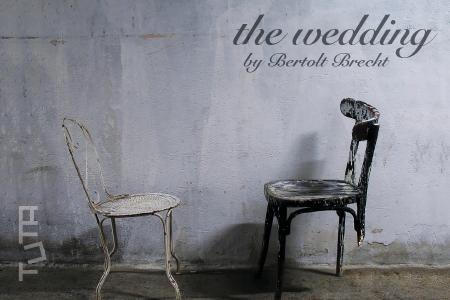
Tuta Theatre Chicago
Chris Jones, Chicago Tribune 1/19/10 "TUTA's winter show is quite the enjoyably quirky 90 minutes.…a cross between the song stylings of Kurt Weill, "The Wedding Singer" and "Mamma Mia," and they are exceedingly funny.
CRITIC's PICK - John Beer, Timeout Chicago 1/21/10 - "..The Wedding has the raw energy of a boxing match; this riotous production manages to be at once thrilling, tender and very funny"
| buy tickets |
 |
 |
 |
 |
 |
 |

01/14/10 - 02/14/10
Thu-Sat 8p; Sun 3p. $25/20.
3 of 4 stars - Chris Jones, Chicago Tribune 1/19/10 - "Whether on film, stage or TV, the nuptials from hell have proved to be one of drama's most popular set-pieces. The stakes are high, the characters are familiar and the situation imbued with natural tension. Plus, we like watching lousy weddings. It stops us from worrying about what happened (or will happen) at our own.
So you might say that Bertolt Brecht's "The Wedding" (also known as "A Respectable Wedding") was a prescient little dark comedy in 1919, except that Shakespeare surely got there first with "The Taming of the Shrew." This is, by the lofty standards of Herr Alienation, a minor bit o' Brecht. But it's an uncharacteristically jolly little look at a wedding collapsing.
Literally. Much of the amusement here comes at the expense of the groom, who built all the flimsy furnishings himself.
Chicago's T.U.T.A. is known around town for its fulsome, earnest, Euro-style takes on Chekhov and the like. But it is now embarking on an exploration of those typically neglected early Brecht plays. And while it misses some of the class conflicts in the original text, T.U.T.A.'s winter show is quite the enjoyably quirky 90 minutes.
Director Zeljko Djukic cast a clutch of droll Chicago character actors, from Ben Harris (who has a Blago-like ambiance) to Laurie Larson, who consistently amuses despite saying, well, nothing.
These folks sit at a long table. They eat, drink, dance, speechify, celebrate, complain, copulate and collapse. The bride's sister (amusingly played by Jamielyn Gray) commits indiscretions. The bride reveals a secret. The groom reveals insecurity. The furniture falls apart. I don't know about you, but I've seen all of those things at real weddings. This anti-romance just stuffs them all together into the basement of the Chopin Theatre.
The show's best moments, though, come when people start to sing.
With the help of Jesse Terrill's deliciously original music, Djukic has fused into the text a variety of eclectic, contemporary ballads. They come off as a cross between the song stylings of Kurt Weill, "The Wedding Singer" and "Mamma Mia," and they are exceedingly funny -- especially when the guests form a variety of impromptu bands, replete with drums, accordions, cheap harmony and thinly veiled desperation"
Justin Hayford, Chicago Reader 1/21/10 - "Bertolt Brecht wrote his one-act The Wedding in 1919, the same year he joined the Independent Social Democratic Party—the leading faction behind the Bavarian Soviet Republic, which lasted all of a month. Although Brecht's infatuation with Bavarian-style communism was short-lived—and what reasonable person could support a regime that declared war on Switzerland?—his earliest plays twitch with the revolutionary spirit that filled the air in his homeland.
In The Wedding Brecht deploys the iconic characters and satirical bite that made his cabaret songs such a scandalous sensation, taking aim at the affectations, fake morality, and herd mentality of the shopkeepers and low-level professionals who make up the petite bourgeoisie (the German title translates literally as "The Petit-Bourgeois Wedding"). The setting is the wedding feast of a wholly ordinary group of friends and relations—given generic names like the Bride, the Groom, the Bride's Father, the Bridegroom's Mother—who strive mightily against their baser instincts in the hope of achieving respectability. The Bride's Father wants to impart pearls of wisdom to the assemblage, but can tell only stories of people dying from dropsy or throwing up all over a dinner table. The Bridegroom's Friend makes exemplary displays of his fine manners, repeatedly covering smoothly for the others' inappropriate remarks—but when he's asked to perform a song, he responds with one about a man who forsakes his chaste lover to learn sex from a prostitute ("Spread her on the stairs and banged her / Laughing at propriety.")
As the party progresses and alcohol loosens tongues, rudeness gives way to cruelty. At some point every guest makes a crack about the bride's questionable virginity, even as each one reveals an unseemly lascivious side (two of them end up screwing—loudly—in the kitchen). It becomes clear that the spiteful guests imagine they can up their own social status by tearing the others' down. Decorum collapses at roughly the same pace as the Bridegroom's shoddy, homemade furniture.
On a superficial level, The Wedding is a farce, but Brecht saw real danger in middle-class pretensions. "If you don't press us hard, yell at us, and punch us in the face, we will remain like pathetic rag dolls," Brecht imagined them saying in a later essay; he concluded, with chilling irony, "Luckily a leader was found and they gave him power." Some critics have gone so far as to see The Wedding as "a historical document on the birth of the German version of fascism." That may be a stretch, but Brecht's contemporaries could hardly miss the play's weighty politics.
To a 21st-century Chicago audience, post-World War I Bavaria may as well be the moon, and director Zeljko Djukic doesn't try to reconstruct the play's political moment. His production for TUTA Theatre Chicago slips in enough anachronisms—one guest photographing an embarrassing moment with his cell phone, another singing an Elvis Presley tune to the wedding party—to wrest the proceedings from their original historical context. And in typical fashion, Djukic has assembled a smart, meticulous cast who find rich, subtle humor in the disasters that befall their characters.
The first half of this 70-minute show is great fun. But in transplanting The Wedding to the contemporary realm and sealing the cracks with heavy patches of irony, Djukic eliminates class consciousness from it, and therefore any meaningful stakes. The members of this wedding party aren't struggling to rise above their low social status or banish others to social oblivion; eliminating social strictures also eliminates Brecht's political satire, and turns the guests' actions into mere drunken misbehavior. It's fun for a while, but it doesn't matter"
CRITIC'S PICK - John Beer, Timeout Chicago 1/21-1/27/10 - "The young Brecht (21 when he wrote this satire) compared his ideal theater to a sporting event, one in which the audience would not be lulled into reverie but shocked into enthusiastic engagement. In Djukic’s skilled hands, The Wedding has the raw energy of a boxing match; this riotous production manages to be at once thrilling, tender and very funny.
The story is, to be sure, almost transparently thin. A young man (Trey Maclin), who takes an odd pride in designing and building his own furniture, and his pregnant bride (Jennifer Byers) host a wedding reception for friends and family: her doddering father (Kirk Anderson); his lecherous friend (Andy Hager), who, invited to sing a song, offers a brazenly sexual ditty; and a company of eccentric and loutish characters. “Go to hell!” the young man shouts after them once they leave.
What makes the production such a joy is the accumulation of stunning theatrical moments offered by this tightly chaotic ensemble. Maclin gazes mournfully at the couples dancing around his unmatched figure. One drunk, cuckolded guest (Christopher Popio) tries fitfully and vainly to finger the chords of “I Can’t Help Falling in Love,” while the bride’s father gleefully launches into “Deutschland Über Alles” on the piano. Meanwhile the groom’s furniture collapses around the group. Brecht’s play may not have the charge it once did; the bride’s pregnancy, for instance, seems less of an unmentionable scandal. But like a deranged, avant-garde episode of Curb Your Enthusiasm, The Wedding offers a vertiginous look at the comical depths to which a social gathering can plunge".
Catey Sullivan, Windy City Times 1/20/10 - "We've all been there—witnesses to the wedding that no good will come of, either in the long run for the newly declared spouses or in the short term for the guests unleashed on the open bar. Lurking behind the celebratory smiles and congratulatory toasts are snipes and second guessing, an undertow of abrasive cacophony and impolite honesty laced through the industrial strength happily-ever-after choreography. One clue that something is horribly, hilariously amiss? When every single dish on the dinner menu is gelatinous, starting with a quavering chartreuse codfish entrée and ending with a blood red pudding that wriggles like mites in a distressed intestine.
So it goes with Tuta's staging of Bertolt Brecht's The Wedding, which under director Zeljko Djukic presents bourgeois matrimony as a folly of looming catastrophe. The wedding dinner fish-mold is just the start of the breakdown.
Key to the absurdist charm of the boisterous, 70-minute romp is Djukic's ensemble, a seamless crew with precisely the right blend of raucous pep and obnoxious snark. It's a formidable feat. Creating a credible wedding reception—the guests getting progressively drunker and behaving with corresponding spontaneity as the toasts wear on—is not a job for amateurs. The very nature of the event being staged defies the essence of scripted drama, i.e., the script. If the outbreaks of dancing foolery, off-kilter warbling and lust-addled gropings don't feel wholly impromptu, all is lost. Djukic's cast pulls it off with verve. Conversational lunacies ( "Cows never eat fish. They're vegetarians." ) come fast and furious and with the light, improvisational feel of a tipsy gathering growing tipsier by the moment.
Martin and Rose Kramer's adaptation is rich in revelry and revelations, from the Bride's Father's ( Kirk Anderson ) dismaying anecdotes about dropsy to The Bridegroom's Friend's ( Andy Hager ) illicit cell-phone shenanigans. An intensely physical piece, The Wedding also lets the cast let loose its inner clown: As The Bride's Sister, Jamielyn Gray sports a Jersey Shore coiffure and a keen sense of raucous comedy. As The Wife, Jacqueline Stone is a happy hussy making the most of her character's well-received bawdiness.
As for the Bridegroom ( Trey Maclin ) and the Bride ( Jennifer Byers ) , their journey from carefully calibrated joy to flailing vexation is a journey worth watching, a thing of silliness and despair, and in the end, a cutting commentary on the ludicrousness of matrimonial bliss.
Underscoring the devolution of the wedding party, Martin Andrew's deconstructionist beauty of a set. The exploding lamp at the top of the show is but a harbinger of the literal breakdowns to come.
Equally important is the piece's music, a mix of original pieces by Jesse Terrill and schmaltzy wedding standards. Music director Ben Harris ( who also plays the Young Man ) helms pitch-perfect singalongs and solos. If laughing gas could be heard, it would sound like this: Giddy, uninhibited and infectious".
Author
Bertold Brecht
Director
Zeljko Djukic
Performers
Kirk Anderson; Laurie Larson; Jennifer Byers; Jaimelyn Gray; Trey Maclin; Andy Hager; Jacqueline Stone; Christopher Popio; and Ben Harris.
Production
Original Music - Jesse Terrill
Scenic Design - Martin Andrew
Costume Design - Natasha Djukic
Lighting Design - Keith Parham
Sound Design - Nick Keenan
Stage Manager - Helen Lattyak
Musical Direction - Ben Harris
Tags: Theater, Old Europe, 2010

